
History of Adult Education in Louisiana
For more than a century, Louisiana educators have worked to open a second door to learning for adults who missed the first one. The effort has started, been interrupted, and restarted many times: through a governor’s literacy drive, Depression-era relief programs, the GI Bill, state and federal law, and the professional associations that carried the work between budget cycles. This page traces that story from the colonial era to today.
Before 1919 | Louisiana’s Early Adult Learners
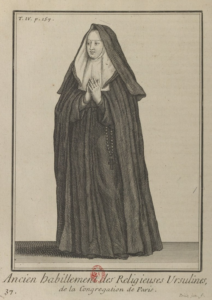
Engraving of an Ursuline nun 1714-1719
Adult learning in Louisiana began long before the state funded it, and for most of the 1800s, access depended on law, money, and race. In 1727, the Ursuline nuns arrived in New Orleans to educate women and girls. Their work included religious instruction for free and enslaved women of color, and some free women of color learned to read and write. In 1830, the Legislature made it a crime, punishable by up to a year in prison, to teach an enslaved person to read or write.
New Orleans built Louisiana’s first public adult learning. By the 1850s, every district of the city’s public schools ran night schools for young people who worked during the day, three hours a night for five to seven months a year; one night school enrolled 849 students in 1859. The schools also ran a public lecture series, meant to “extend to the many the inappreciable advantages of knowledge,” and a public library of more than 12,000 volumes by 1861. Like the city’s day schools, all of it was open only to white residents.
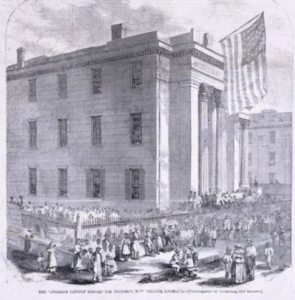
The Freedmen’s Bureau opened the Abraham Lincoln School in New Orleans in October of 1865
Emancipation opened the door wider. In 1864, the Union army’s Board of Education in the Department of the Gulf set up schools that reached more than 9,500 children and 2,000 adults by year’s end. At their 1865 peak, Freedmen’s Bureau schools in Louisiana had 230 Black and white teachers and 19,000 students, among them 1,000 Black soldiers and 4,000 civilian adults, despite unpaid teachers and violence against schools.
Later in the century, adult learning took new forms. The Louisiana Educational Association founded the Louisiana Chautauqua near Ruston in 1889, and thousands of adults came each summer for lectures, music, science, and teacher institutes until it closed in 1905; a Louisiana Colored Chautauqua began at Grambling in 1906. In New Orleans, a public night school opened in 1903–04; Act 214 of 1912 gave the Orleans school board express authority to open evening schools to adults, and in 1918–19 the city opened its first evening school for Black adults, in the McDonogh No. 35 building, enrolling 398 in its first year. In 1905, the state teachers’ association named a “commission on literacy,” an early statewide call to end adult illiteracy.
Sources: Lipscomb (2005); Rosenberg (1963); Sullivan (1968); 64 Parishes; The Historic New Orleans Collection; LSU Libraries.
1919–1933 | The First Literacy Campaigns
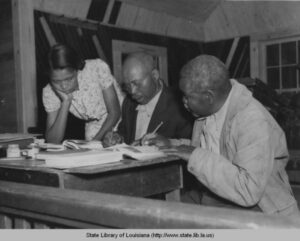
Adult education in Tensas Parish, Louisiana. Photo caption: A 73-year-old man learning to read and write.
The 1910 census counted more than 300,000 Louisianans over age ten who could not read or write. In February 1919, State Superintendent T. H. Harris urged parish school boards to “attack the problem of eliminating illiteracy seriously,” but little followed, and the 1920 census ranked Louisiana last in the nation.
In 1929, Harris and Governor Huey P. Long launched the state’s first statewide literacy campaign, funded by a 1928 malt tax and a $50,000 grant from the Rosenwald Fund and directed by M. S. Robertson. Every parish offered classes in a 24-lesson course in reading, writing, and arithmetic, taught by regular teachers in the late afternoons and evenings. More than 100,000 adults enrolled in 1929–30, more than 80,000 of them Black Louisianans, and each graduate received a diploma signed by the governor. The 1930 census showed adult illiteracy falling from 21.9% to 13.5%, the largest drop of any state. The Depression ended the campaign after the 1932–33 school year.
The 1921 state constitution required public school instruction in English. Many of the adults who enrolled in the 1929 literacy campaign, especially in South Louisiana, learned to read and write in English, often not their first language.
Sources: Schumacher (1965); Sullivan (1968); on the language context, Lipscomb (2005); 64 Parishes, “Francophone Louisiana”; Louisiana language laws by constitution (LHCV).
1934–1949 | Relief Education and the GI Bill
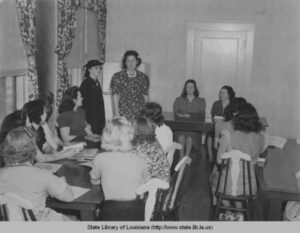
April 18, 1940. Adult education classes conducted by WPA in NYA Home. Shreveport
In 1934, the federal relief programs (first FERA, then the WPA) put unemployed teachers to work teaching adults, again under Robertson. More than 2,000 teachers taught over 88,000 adults in the first year, and about 255,000 adults had enrolled by 1937. Demonstration literacy projects in Tensas, Lafayette, and Terrebonne parishes in 1937 led to a new statewide literacy campaign in the fall of 1938.
The program closed on February 1, 1943, when the WPA was liquidated. In his farewell letter, Robertson urged superintendents to “incorporate Adult Education in the regular school program.”
After World War II, the GI Bill reopened classrooms to adults. Under a 1949 contract with the Veterans Administration, parish schools taught veterans from the first grade through high school; enrollment peaked at 34,763 veterans in 1951.
Source: Schumacher (1965).
1950–1964 | Act 252 and the Professional Associations
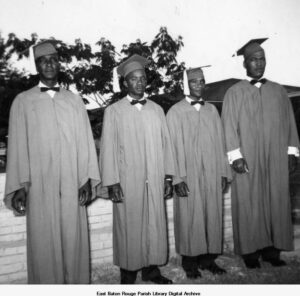
Chaneyville High School Adult Graduating Class 1960
In 1950, at State Superintendent Shelby M. Jackson’s request, the Legislature passed Act 252, which appropriated $25,000 a year for two years “for the development of Adult Education on the elementary and secondary level and to aid in eliminating adult illiteracy.” Later legislatures renewed and expanded the program to $350,000 a year by 1960.
The Legislature described the program’s purpose as helping Louisianans “obtain economic security,” strengthen agriculture, business and industry, and “further the democratic ideals of providing education for all who desire it.”
Parish school boards ran evening classes at the elementary and high school levels, and adults who completed high school–level work could earn a high school equivalency certificate through the GED. By 1955, 54 parishes enrolled 12,124 adults; by July 1963, 9,727 equivalency certificates had been issued.
Adult educators also organized. By 1951, the Louisiana Teachers’ Association, the state’s association for white teachers, listed an Adult Education Section among its departments. The Louisiana Education Association, the association for Black teachers, had an adult education division by 1938 and held adult education sessions at its conventions through the 1960s. By 1960, adult educators also met statewide as the Louisiana Association of Public School Adult Educators (LAPSAE), during the same Thanksgiving week as the LTA’s conventions.
The historian of this era, Edward Schumacher, concluded in 1965 that Louisiana’s efforts had been “intermittent, limited in scope, and inadequately financed.”
Sources: Schumacher (1965); Sullivan (1968); Black Teacher Archive (LEA journals); Act 252 of 1950 (Acts of the Legislature, 1950).
1965–1975 | Adult Basic Education and the Road to LAPCAE
 The federal Economic Opportunity Act of 1964 created Adult Basic Education (ABE), and Louisiana began ABE in 1965. The Adult Education Act of November 3, 1966, moved the program to the U.S. Office of Education. Louisiana used federal ABE money for elementary-level classes, which freed state money for high school classes. Enrollment more than doubled in one year, from 10,308 adults in 1964–65 to 22,163 in 1965–66.
ABE built a profession. Parishes hired adult education supervisors (15 full-time by 1974, up from one before federal funds), along with counselors and paraprofessionals, many of them program graduates. Louisiana’s first full-time adult learning centers opened in Monroe, Alexandria, and Baton Rouge in 1969–70. Louisiana had the nation’s highest GED pass rate in five years between 1963 and 1971.
LAPSAE published a quarterly newsletter, The LAPSAE Leader, from about 1969, and documented waiting lists of more than 14,000 adults for high school classes in 1969–70. In 1972, Act 113 appropriated an additional $1 million from the state general fund for adult education.
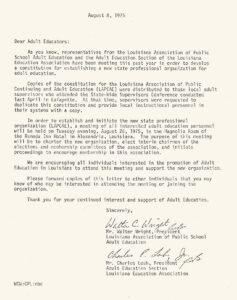
By the mid-1970s, LAPSAE had integrated leadership, including President Walter Wright (New Orleans) in 1974–75. In 1975, LAPSAE and the Adult Education Section of the Louisiana Education Association chartered a single new organization: LAPCAE. The two K-12 state teachers’ associations did not merge until 1977.
Sources: Louisiana Adult Education Staff Development Project training manual (1974); LAPCAE history; Webb (1978); Act 113 of 1972.
1975–2010 | A State Division and a Changing Federal Law
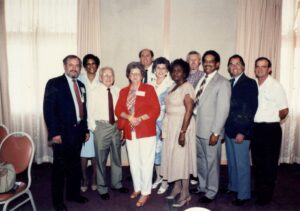
Charter members of LAPCAE were recognized during the convention. (L to R) Ted Schilling, Marie Meno, Claude C. Couvillion, Rudy Beadle, George Varino, Betty Grow, Doris Pollard, Bobby Boyet, Charles Loeb, Cookie Gomez, and Robert Arceneaux. June 1985.
Act 274 of 1975, which reorganized Louisiana’s education laws under the new State Board of Elementary and Secondary Education, required “a separate division” of adult and community education in the State Department of Education, with its own director, to run a statewide program “to eliminate adult illiteracy” and award elementary certificates and high school equivalency diplomas. Local school boards operated the classes with state allocations. A 1977 reorganization placed the division in the department’s Office of Auxiliary Programs. Its leaders included George Bertrand (State Director, 1978) and Glenn Gossett, who led the Bureau of Adult and Community Education from at least 1981 to 1996.
Federal law kept widening who adult education served. Amendments to the Adult Education Act added programs for refugees from Southeast Asia (1976) and adult immigrants (1978), and in 1988 added English literacy and workplace literacy grants. The National Literacy Act of 1991 created the National Institute for Literacy and a network of state literacy resource centers.
Louisiana built its own literacy infrastructure in the same years. In 1989, the Legislature created a state Office of Literacy in the governor’s office to coordinate public and private literacy efforts, and by 1990–91 state law set a minimum state funding level of $164.11 per adult student. A 1991 law, still on the books, created family literacy demonstration projects pairing adult education for parents without a diploma with early learning for their preschool children.
In 1998, Title II of the federal Workforce Investment Act, the Adult Education and Family Literacy Act, replaced the Adult Education Act. It opened services to adults 16 and older not enrolled in school, added family literacy, introduced performance indicators that every state reports through the National Reporting System, and required states to contribute at least 25% of program costs. The same year, Louisiana created the Louisiana Community and Technical College System. In 2002, the Legislature allowed 16- and 17-year-olds to enroll in adult education. In January 2010, after years of serving tens of thousands of adults a year, the program absorbed a mid-year cut of 67% in state funding.
Sources: Act 274 of 1975; Act 83 of 1977; Louisiana R.S. 17:14 (history notes), 17:14.1, 17:221, 17:3931; 20 U.S.C. ch. 30 (historical notes); Congressional Research Service, RL30106 (1999); Louisiana NRS narrative report (2009); LAPCAE conference programs.
2010–Today | Adult Education & WorkReady U
On July 1, 2010, Act 132 moved adult education from the Department of Education to the Louisiana Community and Technical College System (LCTCS) and directed its board to fund a statewide program “based on an adopted formula,” using quality indicators and performance criteria. LCTCS launched WorkReady U as the statewide adult education network. In 2011–12, WorkReady U spent about $14.8 million on adult education, including $4.6 million in state funds, and served more than 27,000 adults.
In 2014, Louisiana adopted the HiSET as its high school equivalency test. The same year, Congress passed the Workforce Innovation and Opportunity Act (WIOA), which tied adult education more closely to workforce development and to students’ transitions into college and training. WIOA’s integrated education and training model has adults build basic skills while they train for a specific occupation, an adult form of dual enrollment that lets students earn college credit and industry credentials while still completing their adult education.
WorkReady U’s focus widened from the diploma to what comes after it. Beginning in 2018, LCTCS policy opened new routes to a high school equivalency diploma for adults 18 and older. In addition to passing the equivalency test, adults can now qualify by completing college preparation coursework, meeting college placement standards, or finishing an integrated career pathway that combines 12 credit hours of technical coursework with an industry-based credential.
The COVID-19 pandemic fundamentally changed adult education. Programs moved instruction online almost overnight, and LAPCAE held its annual conference virtually in 2020 and 2021. Distance learning became a permanent part of WorkReady U. Digital literacy, once treated as a job-readiness skill, came to be recognized as a literacy in its own right, as basic to work, school, health, and civic life as reading and math. The 2021 federal infrastructure law funded state planning for digital skills and internet access, and Louisiana’s 2024 Digital Opportunity Plan named digital literacy as a statewide priority.
Sources: Act 132 of 2010; LCTCS Policy 1.105 (revised 2024); Workforce Innovation and Opportunity Act (2014); Louisiana NRS narrative reports (2011, 2018–19); ConnectLA, 2024 Louisiana Digital Opportunity Plan; LAPCAE conference programs (2020–2021).
A Century in Numbers
How many Louisiana adults needed a second chance at school, how many enrolled, and what the state and federal governments put toward it, from the first literacy campaigns to today. Hover or tap any point for the figure and its source.
1 · The needAdults without a basic education
Show the numbers
2 · Who cameAdults enrolled in adult education
Everyone served by adult education in Louisiana each year, by the fullest available count for that period.
- Act 252 enrollment 1950–51 to 1964–65 (ERIC ED109380); state and federal programs combined 1965–66 to 1984–85 (Department of Education, Statistics of Louisiana Adult Education Programs, Bulletin 1770, 1986, ERIC ED339812); and 1985–86 and 1986–87 from the Department's year-end narrative reports (Bulletins 1799 and 1818); 1987–88 to 2003–04 from the Department's Annual Financial and Statistical Report (1991–92, 1993–94, 1997–98 and 2004–05 editions); 2004–05 from the Louisiana Literacy Plan (2006, ERIC ED497764); 2005–06 and 2006–07 from NRS state tables; and from 2007–08, everyone served one hour or more, from the NRS narrative reports (workforce preparation activities counted from 2015–16). Hover for diplomas earned.
Show the numbers
3 · What it costState and federal funding
The federal line is Louisiana's annual adult education grant allocation from the U.S. Department of Education, with federal Adult Basic Education spending for the program's first seven years. The state line is state funds spent on the program. Switch to 2025 dollars to compare purchasing power across decades.
- 1965–66 to 1971–72 are federal Adult Basic Education expenditures reported by the State Department of Education (ERIC ED109380); 1972–73 to 1979–80 are federal funds as charted in the Department's Bulletin 1770 (1986). From FY1980 the line uses U.S. Department of Education allocations, which match Bulletin 1770 for the years both cover. Federal allocations include the English Literacy and Civics (now IELCE) grant from FY2001. FY2000 shows the basic grant only. FY2018 is the Department's estimate; the final figure is pending.
- State figures for 1950–51 to 1971–72 are Act 252 program expenditures (ERIC ED109380); from 1965–66 they include $50,000 in state matching funds for federal ABE. 1972–73 to 1984–85 are read from a bar chart in the Department's Statistics of Louisiana Adult Education Programs (Bulletin 1770, 1986, ERIC ED339812); a few labels in the scanned copy are partly illegible and are marked approximate. 1997–98 and 2002–03 to 2003–04 are state general fund appropriations in the General Appropriation Acts (Act 18 of 1997, Act 13 of 2002, Act 14 of 2003); 2004–05 to 2006–07 are actual state general fund spending in the Department of Education's Adult Education budget line (Executive Budget Supporting Documents), which may include small amounts for other programs. State funding for 1985–86 to 1996–97 and 1998–99 to 2001–02 has not yet been found. The 2009–10 figure reflects a mid-year state reduction. 2007–08 to 2020–21 are state funds spent, from the NRS narrative reports; 2021–22 to 2025–26 show the state allocation of $4,750,000, unchanged since 2019–20: $2,870,000 appropriated as a separate "Adult Basic Education" line in the LCTCS budget (19A-649) of every General Appropriation Act since 2020, plus $1,880,000 that LCTCS allocates to adult education from the Workforce Training Rapid Response Fund (WorkReady U).
- 2025 dollars use the Consumer Price Index for All Urban Consumers (CPI-U, U.S. city average, annual average; 2025 is an 11-month average because October 2025 data were not collected). Each figure is adjusted from the calendar year in which its fiscal or program year began.